iMaC: Translating Actions into Motion and Contact Images
for Embodied World Models

Anonymous Authors
CoRL 2026 Submission

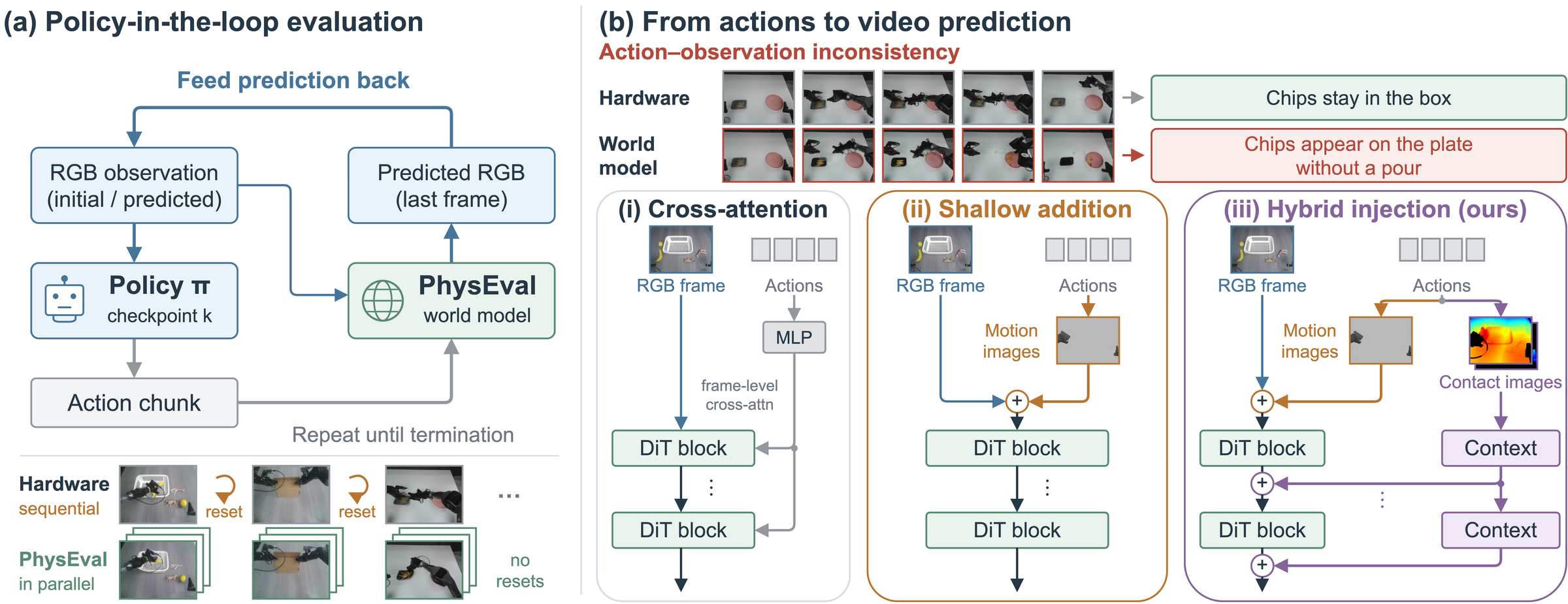
iMaC translates future robot actions into motion images and contact images, enabling embodied world models to predict contact-sensitive future videos for closed-loop policy evaluation.


Abstract

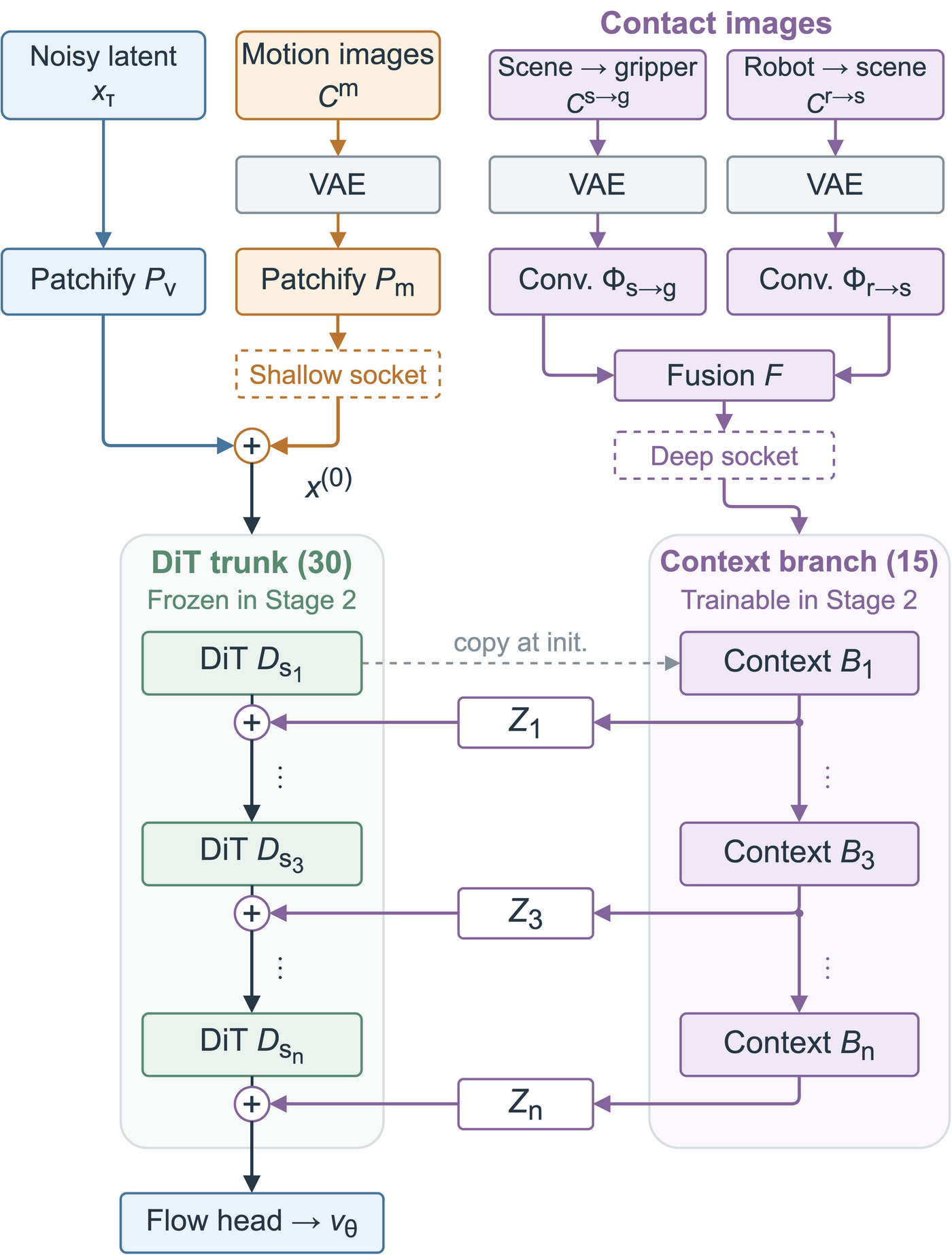
Embodied world models promise to serve as real-world simulators for robot policy evaluation and closed-loop rollout, but their reliability depends on how precisely they condition future video prediction on robot actions. Existing action-conditioned video models often encode future actions as compact vectors, leaving the model to infer fine-grained spatial consequences indirectly. iMaC addresses this by translating future actions into dense image-like controls. It uses robot URDF and forward kinematics to render future robot observations as motion images, and uses RGB-D geometry to construct two-stream contact images that describe robot-scene spatial relations. These controls guide future-video prediction while preserving a scalable image-to-video modeling interface.


Pipeline

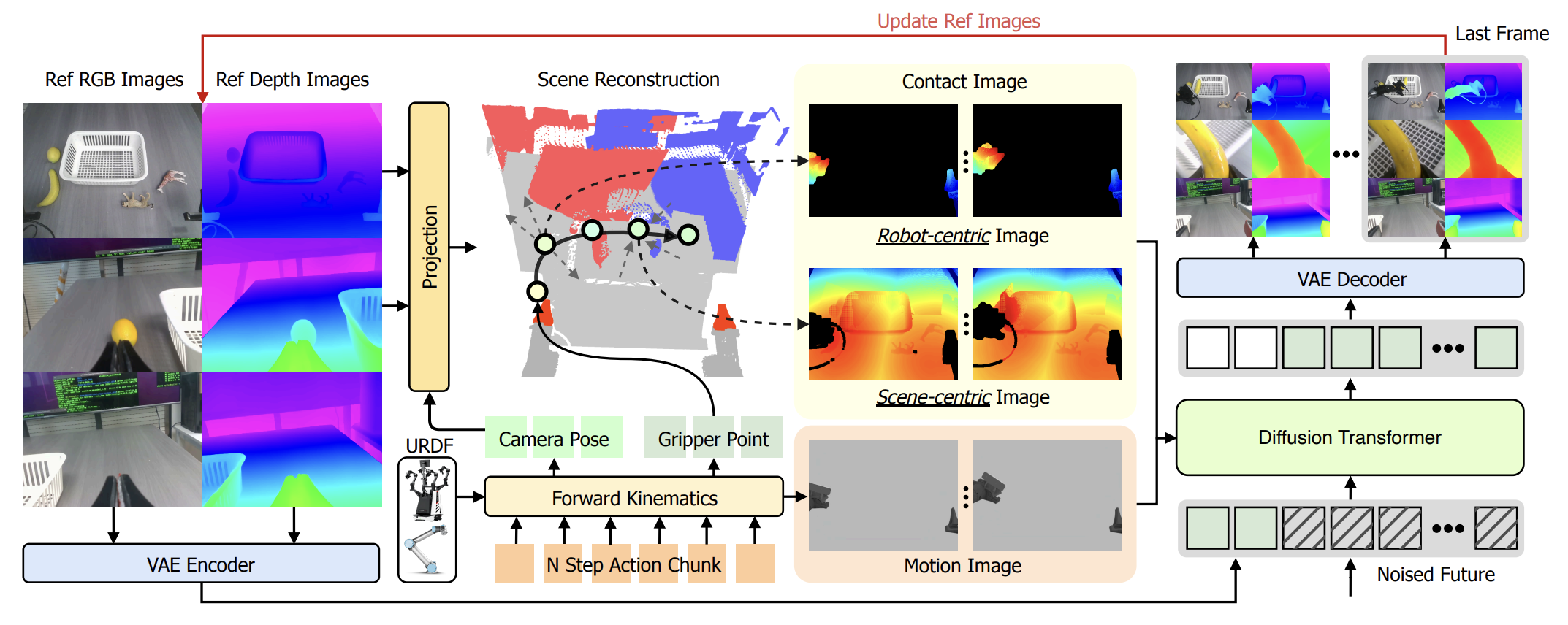
Overview of iMaC translating future robot actions into motion images and contact images for action-conditioned future-video prediction.

Given a reference RGB observation and a future action sequence, iMaC converts joint actions into future robot configurations through URDF and forward kinematics. Rendered robot observations provide motion-image controls. Auxiliary depth prediction and pointcloud geometry provide contact-image controls that describe current scene to future gripper distances and future robot to current scene distances. The controls are injected as video/image controls into the future-video world model.


Generated Results and Conditions

Head View
Left Wrist View
Right Wrist View
Generated Results:
RGB Video
Condition Video:
Motion Image
Condition Video:
Contact Image:
Scene-to-Gripper
Condition Video:
Contact Image:
Robot-to-Scene

Each task shows the generated RGB rollout together with its action-derived controls: URDF/FK motion images, scene-to-gripper contact images, and robot-to-scene contact images across the three camera views.


Policy Evaluation

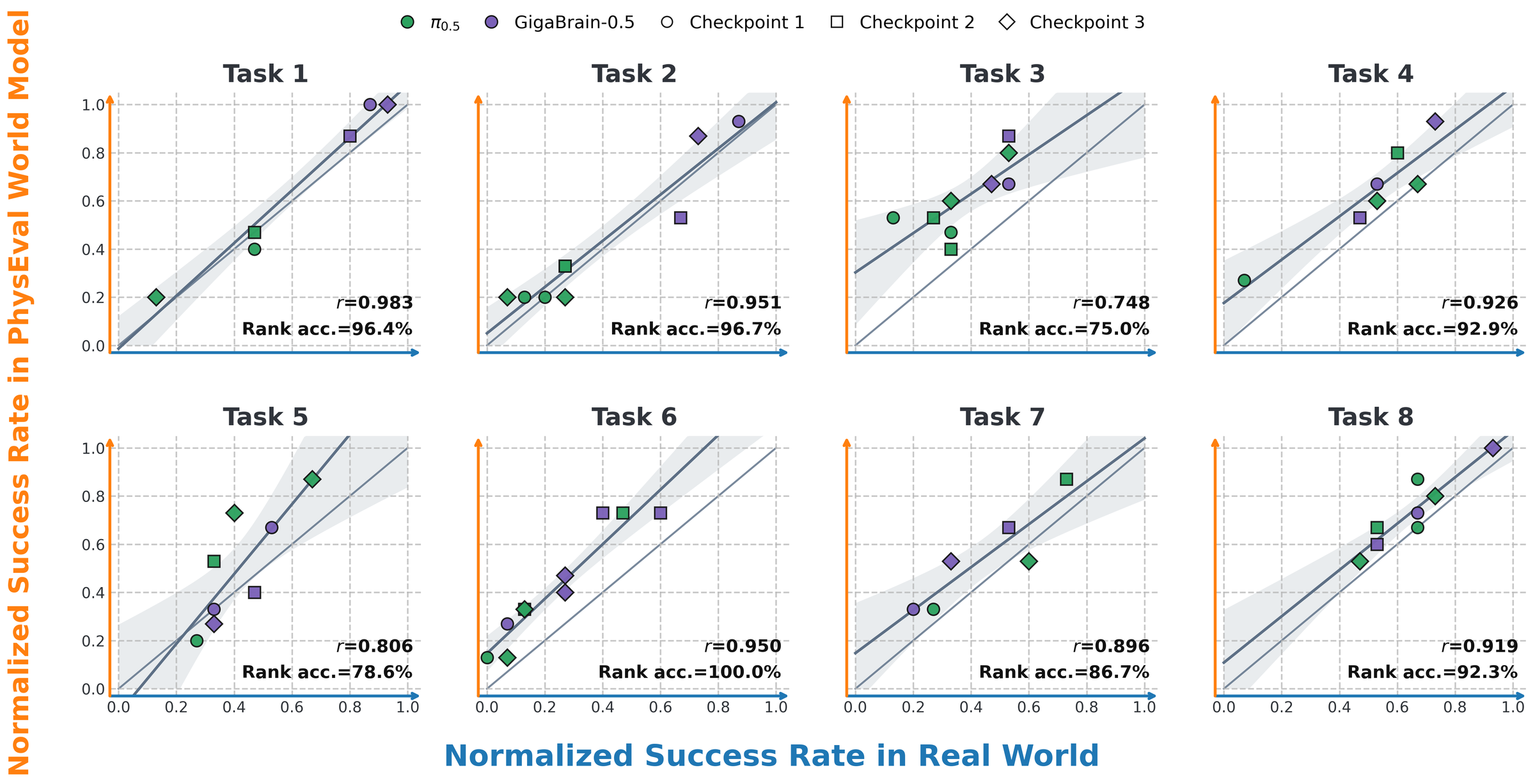
Correlation between normalized real-world success rate and normalized iMaC world-model success rate across eight tasks.

iMaC is designed for evaluating robot policies through closed-loop rollout in a learned real-world simulator. The correlation measures whether world-model scores preserve policy performance across different model families and across checkpoints from the same model, supporting both model comparison and iterative checkpoint selection.